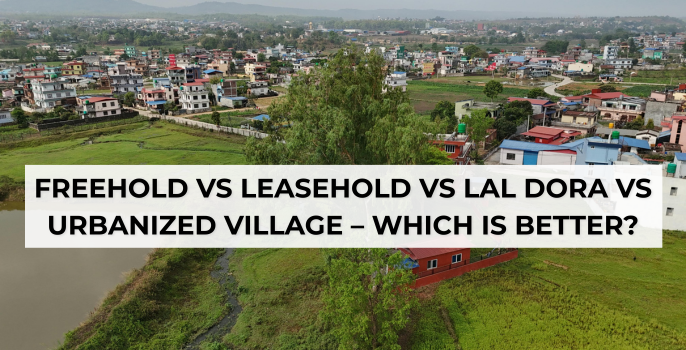
Freehold vs Leasehold vs Lal Dora vs Urbanised Village – Which is Better?
it’s natural to ask about freehold vs leasehold vs Lal Dora vs urbanised village. Each affects registry rights, loan access, resale potential, and your sense of long-term security. Let’s analyse the differences so that you can decide which property type is better for you.
What is a Freehold Property?
Many buyers in the capital city prefer a freehold property in Delhi because it represents complete and permanent ownership. In simple terms, you own both the building and the land beneath it. Once registered in your name, it is yours forever – no renewals as well as rent payable to any authority.
The Overview of a Freehold Property
A freehold title means you control the property completely. You can sell, modify, lease, or transfer it without seeking permission. The ownership deed usually includes the land rights, making it legally strong and perfect for inheritance planning.
Advantages of Owning a Freehold Property in Delhi
- Ownership is absolute with no lease terms attached.
- Transfer and sale are simple, with ready access to bank loans.
- Property values remain high because buyers feel safe investing.
- No recurring lease renewal charges.
Freehold homes are usually found in notified residential zones planned by DDA or cooperative societies.
Common Locations
Several new registry flats in Delhi qualify as freehold, especially those in Dwarka, Rohini, and South Delhi. These are high-demand areas where homebuyers value clarity of title over everything else.
Suitability of these Properties
If you’re an end-user or investor keen on stability and resale potential, a freehold option makes the most sense. It delivers ownership in the truest sense – something that, in Delhi’s chaotic market, gives you peace of mind.
What is a Leasehold Property?
A leasehold property in Delhi operates differently. Ownership rests on a long-term lease granted by a government body or development authority in these properties. The standard lease period is 99 years. However, it can vary depending on the scheme or location.
A Brief Overview
In leasehold properties, you own the building but not the land. The land remains owned by DDA, L&DO, or another government agency. You must renew it to retain ownership rights once the lease expires for a leasehold property in Delhi. It usually involves additional payments or verification.
Pros
- Lower initial cost compared to freehold.
- Premium localities like Connaught Place or Defence Colony have leasehold plots that offer prime addresses at relatively affordable rates.
- Ideal for those seeking prestigious areas with limited budgets.
Cons
- Renewal can become expensive and bureaucratic.
- Major modifications require approval from the lessor.
- Financing is tricky, as some banks hesitate to offer home loans for such titles.
- Resale value can decline as the lease nears expiry, which can worry investors.
Still, many people buy leasehold properties in Delhi to gain access to central locations that freehold plots can’t match in price.
What is Lal Dora Property?
The term Lal Dora property meaning confuses plenty of buyers, yet these plots form a major part of Delhi’s expansion story. These are sections of land within village boundaries marked by a red line on old revenue maps – exempt from building bylaws and municipal taxes when identified.
Overview of Lal Dora Property
Lal Dora property meaning refers to old village areas that became part of Delhi’s jurisdiction but were never brought under conventional urban regulation. Residents often build without following DDA norms or getting formal layout approval.
Issues with Lal Dora Properties
- No legal registry, making it difficult to secure loans.
- Lack of standard infrastructure and poor documentation.
- Greater risk of disputes over boundaries and inheritance.
Despite these issues, thousands still live in Lal Dora zones because of affordability and flexible construction norms.
Pros
- Significantly cheaper than organised colonies.
- Larger plots offering open space and community-centric life.
- For longstanding village families, properties carry emotional value alongside convenience.
Buying here can be tempting for short-term cost reasons, but without regularisation, it carries long-term uncertainty.
What is an Urbanised Village Property?
As Delhi expanded, many old villages received upgraded roads, sewer systems, and utilities while officially entering municipal limits. These properties are known as urbanised village Delhi property. They present an intermediate choice for buyers caught between cost and formality.
Urbanised Village Property at a Glance
Urbanised villages maintain historic layout patterns but function as part of the city. The residents enjoy better amenities and partial legal clarity, though some paperwork delays remain for subdivisions and resale.
The Location of These Properties
Numerous South Delhi property types belong to this category. This includes Chhatarpur, Saidulajab, and Najafgarh. These are suburban belts suitable for working professionals seeking independent as well as affordable properties.
Pros
- Improved infrastructure with road connectivity and basic facilities.
- Urbanised village Delhi property prices stay moderate while enjoying city access.
- Resale is far smoother than in the Lal Dora areas.
- Buyers can expect consistent appreciation as urbanisation deepens.
Freehold vs Leasehold vs Lal Dora vs Urbanised Village – The Key Differences
These four categories differ sharply in legal clarity, risk, and resale strength. The table below highlights the most relevant points for quick comparison.
Each category suits a different budget and risk tolerance. It means your priorities should drive your choice more than general perception.
Which Property Type Is Best for You?
The real question is which property type is better for your situation now that you understand their characteristics. Here is what you should know.
For most middle-class homebuyers, a freehold or an urbanised village property delivers the right mix of safety and value growth.
Impact of PM UDAY Scheme on Lal Dora & Urbanised Village Properties
The government’s PM UDAY regularisation initiative has started transforming informal land ownership in Delhi. It offers ownership certificates and digital mapping support for long-established dwellers, improving both market credibility and personal security.
Impact on Lal Dora Properties
When owners in Lal Dora localities register under PM UDAY, they gain formal ownership rights. It changes everything – financing becomes accessible, documentation improves, and resale value rises. It’s a big step forward for residents who have lived for decades with uncertain ownership.
Impact on Urbanised Village Properties
Urbanised villages are also benefiting because the scheme formalises subdivided plots and streamlines the registry. As documentation improves, banks express greater confidence in granting home loans. The process creates new opportunities for redevelopment and modern housing layouts in communities that were previously semi-urban.
Gradually, PM UDAY is making these informal zones part of the mainstream property market, balancing affordability with secure ownership titles.
Conclusion
In short, freehold vs leasehold vs Lal Dora vs urbanised village properties appeal to different categories of buyers. Freehold remains the safest long-term bet. Leasehold stands as a moderate alternative. Urbanised villages bridge affordability and city convenience, while Lal Dora properties stay risky without regularisation.
As the city expands, Bhiwadi is emerging as a promising extension. If you’re eyeing RERA-approved builder floors supported by legal safety and proper ownership, contact Bhavishya Nirman at 9899550700. You can invest in quality homes that combine reliability with comfort.
Search Blog
- Maple Apartment
- Hibiscus Apartment
- Marigold Apartment
- Cosmos Apartment A*B
- Cosmos Apartment C
- Camellia Apartment B&C
- Camellia Apartment E
- Camellia Apartment A
Our Properties
Recent Posts


Is Buying Flats Safe In Chattarpur?
21 Sep 2023