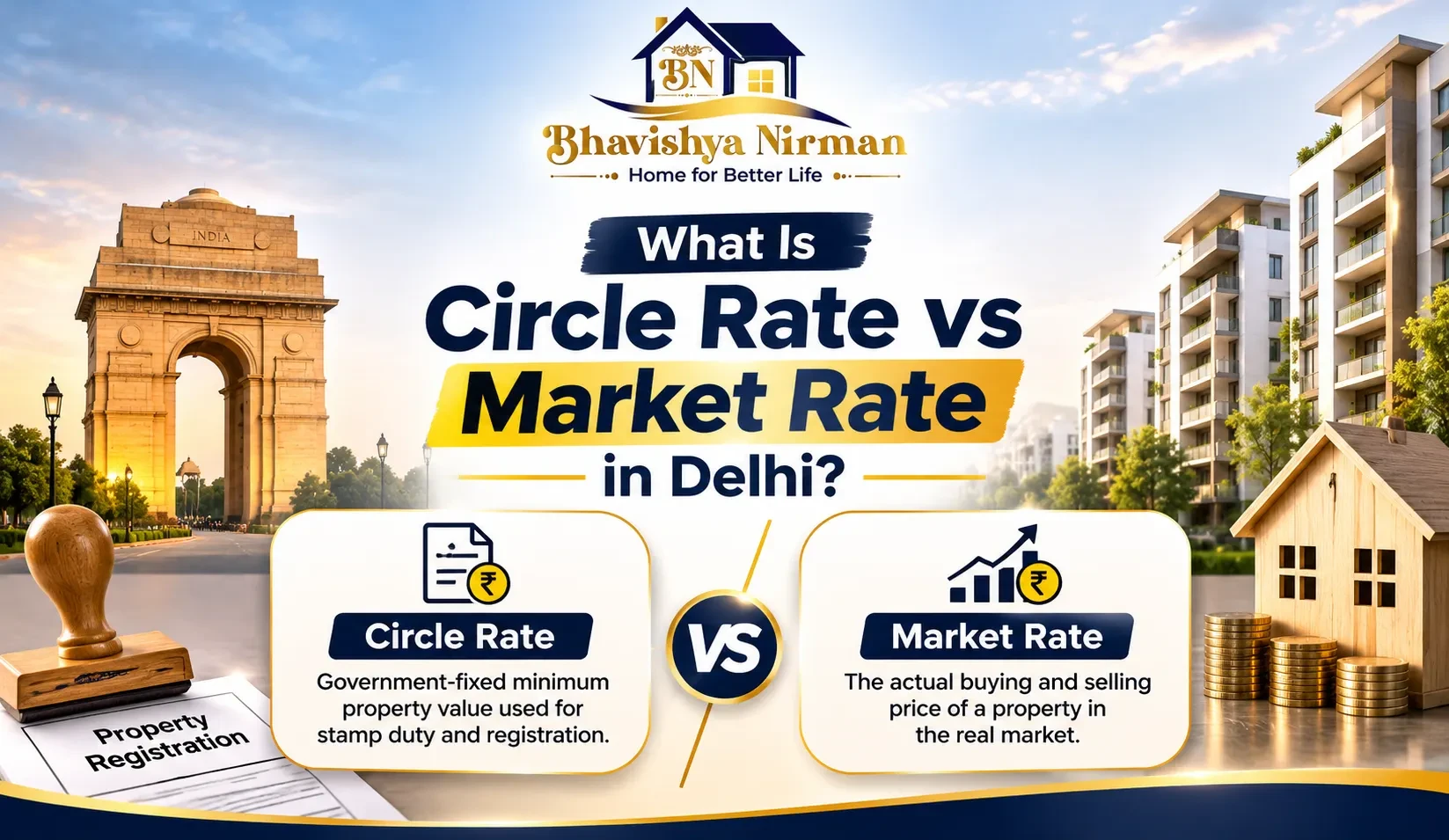
What Is Circle Rate vs Market Rate in Delhi?
Finding real estate in Delhi involves much more than choosing the right prices and locations. Understanding government valuations and market rates is just as crucial before you decide to buy. Two key terms that each homebuyer must know are circle rate and market rate. While both are related to the property rate, they have distinct functions.
Knowing What Is Circle Rate vs Market Rate in Delhi? will enable you to know your registration costs, property costs, and make better home buying or selling decisions.
What Is Circle Rate in Delhi?
Circle Rate is the minimum property valuation rate notified by the government for various purposes such as stamp duty and registration of property transactions. The circle rates of Delhi have been notified by the Government of the National Capital Territory of Delhi in its Revenue Department.
The relevant valuation would depend on various aspects such as the location, nature of property, type of property/land, area of property, and relevant valuation rules. As some of the valuations of properties in Delhi follow locality-wise categorization, the rates may vary from one locality to another.
The circle rates are relevant due to their use as the government benchmark valuation for property registrations.
What Is Market Rate in Delhi?
Market rate is defined as the price at which any property can be bought or sold based on market conditions. The market rates differ from the circle rates in the sense that market rates are affected by the demand of the buyer, the expectations of the seller, property status, and overall real estate activity in the area.
For instance, the market price of an apartment in South Delhi can be higher than the price of a similar apartment in another location because the apartment in South Delhi enjoys all the advantages.
It is important to note that market rates can differ depending on other factors such as the floor level of the property, quality of construction, presence of parking, age of the property, its features, and space.
Circle Rate vs Market Rate: Key Differences
Difference:
- Circle rate: Valuation method recognized by the government that helps determine transaction-related costs.
- Market rate: Price of a property on which buyers and sellers can agree.
- Use: Circle rates help in valuation, whereas market rates enable buyers and sellers to understand the economic value.
- Differences: Market prices can vary widely among different properties located in the same place, while circle rates are calculated based on relevant government guidelines.
- Planning: Circle rates help determine statutory transaction costs, whereas market rates help buyers to set their budget and arrive at the right price.
Neither of the above figures should be considered solely for determining whether the property is worth buying.
Example: How Circle Rate and Market Rate Differ
Assume that you wish to buy a residential plot in Delhi where the negotiated market price of such a plot is ₹80 lakh. For the sake of illustration, assume the circle rate valuation of the property is ₹65 lakh.
In this case, the market price is greater than the circle rate valuation. The consideration value of such a transaction would normally be important to compute the stamp duty.
Now assume the circle rate valuation of the property is ₹90 lakh, and the market price is ₹80 lakh. As per the Revenue Department of Delhi, stamp duty on the property would normally be computed on either the consideration value or the circle rate valuation, whichever is higher. In this case, the valuation used would normally be ₹90 lakh.
The above valuations are for illustration purposes only and not the actual valuations for a Delhi locality. Check how to calculate and check the circle rate.
How Do Circle Rates Affect Property Buying Costs?
Circle rates have the potential to affect the amount that the buyers have to budget for the stamp duty and registration. In the case of Delhi, it has been observed that according to the guidelines of the Revenue Department, the amount of stamp duty that is payable for a sale deed or conveyance deed is 6% for male buyers and 4% for female buyers, based on either the consideration value or circle rate, whichever is more. The registration charges are normally calculated separately. The buyer should verify the current charges before making a decision. A higher consideration will affect the amount payable for these purposes, irrespective of the lower negotiated amount.
Prior to finalizing a property, one should obtain the estimated charges for stamp duty, registration charges, and other expenses.
How to Check Circle Rates in Delhi
One can refer to the official website of the Delhi Revenue Department for notifications of any circle-rate and property registration-related issues.
It is important to check the locality category, the land or property category, the area involved, and the valuation technique for each of the rates one uses. For any property with irregular construction, part sale, or any other issue, contact the Sub-Registrar office.
For market rates, one should consider previous sales, speak to experts in property, and compare the property price to similar ones in that locality. Not all asking prices represent actual selling prices.
Make an Informed Property Decision
The concept of circle rate and market rate in Delhi will allow you to plan your budget accordingly and not be taken by surprise while registering for your property. Circle rates offer a valuation standard, and market rates give you the commercial value of the property.
At Bhavishya Nirman Developers, we ask our clients to thoroughly investigate their options, check all documents, and know the cost of their transactions when buying a home. You may be considering a home in South Delhi or any other region of Delhi NCR.
Frequently Asked Questions
Q1. Are circle rate and market rate the same thing in Delhi?
Ans. No. Circle rate is the government-notified value, which is used to determine registration cost, whereas market rate is the actual rate of transaction between the seller and buyer.
Q2. Is it possible that market rate is lower than circle rate?
Ans. Yes. The negotiated price can be lower than the applicable circle-rate valuation. Stamp duty calculations will usually be done based on whichever figure is larger: either the consideration or the applicable circle rate value.
Q3. How do I know the circle rate for the property in Delhi?
Ans. Refer to the Delhi revenue department's website and confirm the circle rate for your property depending on the locality category.
Q4. Is circle rate relevant to stamp duty in Delhi?
Ans. Yes. According to the published guidelines of Delhi, the stamp duty charged on a sale deed will be calculated based on the consideration or the circle rate value, whichever is higher.
Search Blog
- Maple Apartment
- Hibiscus Apartment
- Marigold Apartment
- Cosmos Apartment A*B
- Cosmos Apartment C
- Camellia Apartment B&C
- Camellia Apartment E
- Camellia Apartment A
Our Properties
Recent Posts


4BHK House Construction Cost in India
20 Apr 2024